FAQ: Christian Persecution
Common questions about the scale, definition, and reliability of data on Christian persecution worldwide. Figures below cite independent trackers; country-level detail is on the map.
Aren’t Christians the most persecuted religion simply because they are the largest group?
No. Christianity is the world’s largest religion (roughly 2.3–2.5 billion adherents), but the leading trackers go beyond raw population size. According to the Pew Research Center’s analysis of 2023 data (published June 2026), Christians faced government or societal harassment in 165 countries—more than any other group (Muslims: 143). That pattern has held across years of Pew reporting. Figures below are from named reporting periods and will change as trackers publish updates.
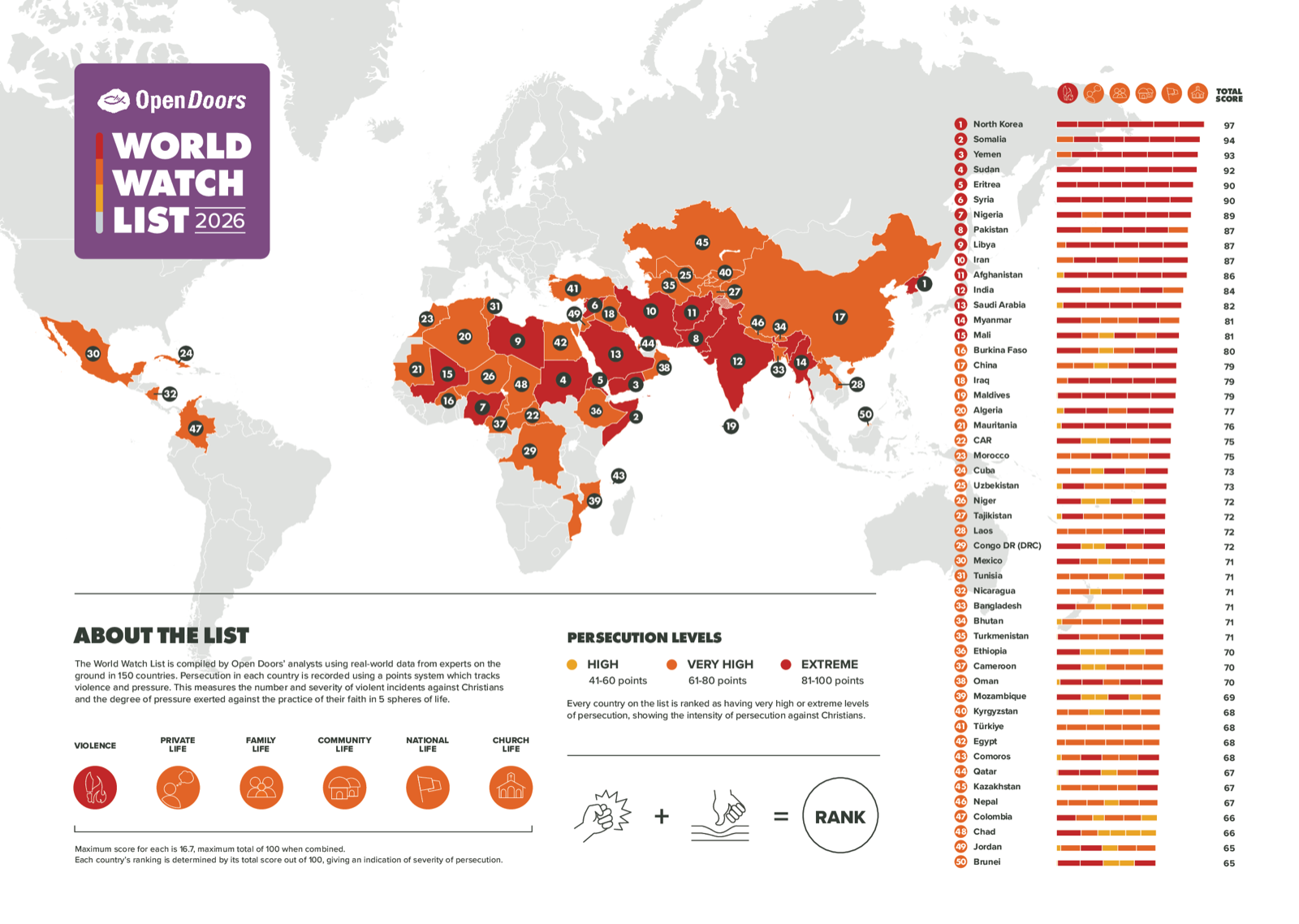
Pew is clear that these figures measure breadth (how many countries report at least one incident), not severity or total victims. Still, Christians’ global dispersion means they are present as minorities in many high-restriction regions, where they face targeted laws, violence, and discrimination rather than only “majority-group” friction. Complementary estimates from Open Doors’ World Watch List 2026 put about 388 million Christians—roughly 1 in 7 worldwide—in areas with high to extreme persecution (WWL 2026 reporting period: 1 Oct 2024–30 Sep 2025).
How does persecution of Christians compare to other religions?
On Pew’s country-count measure, Christians are harassed in the largest number of countries, followed by Muslims. Jews—who make up less than 1% of the global population—faced harassment in 98 countries in 2023 (up from 90 in 2022), showing that smaller groups can experience disproportionately widespread hostility.
Open Doors focuses specifically on Christians and documents severe impacts: during the World Watch List 2026 reporting period (1 Oct 2024–30 Sep 2025), 4,849 Christians were killed for faith-related reasons (Open Doors WWL 2026; not a live count). About 93% of those deaths (4,491) occurred in sub-Saharan Africa, including 3,490 in Nigeria alone (Open Doors trends). Trackers also record church attacks, forced displacement, and ongoing pressure short of killing. No single global system tracks every religious group at the same depth, but Pew’s multi-year series consistently shows Christians experiencing the broadest geographic harassment.
What counts as “persecution”? Isn’t this just normal discrimination?
Definitions vary, but major trackers include both state action and social hostility:
- Government restrictions (Pew’s Government Restrictions Index): laws, arrests, surveillance, bans on worship or conversion, interference in religious practice.
- Societal hostility (Pew’s Social Hostilities Index): violence, mob attacks, discrimination in employment or education, family ostracism, vandalism or destruction of places of worship.
Pew counts a country when sources report even a single qualifying incident that year. Open Doors’ World Watch List scores pressure and violence on a spectrum from high to extreme across dozens of countries in depth. Persecution is not limited to killings; most affected Christians face ongoing discrimination and restrictions that limit free practice of their faith. Faith-related human trafficking, forced labor, and forced marriage of Christians (including religious) are treated as persecution-relevant harm on this site when reporting frames Christians or religious as the victims.
Persecution & Human Trafficking
Religious oppression does not only restrict worship. Legal disability, blasphemy and apostasy pressure, forced conversion, minority stigma, displacement, and weak state protection make Christian communities—especially girls, converts, and the poor—easier targets for traffickers, forced marriage, bonded labor, and sexual exploitation. Trackers such as Open Doors document these pressures country by country; incident samples appear on the map when wired feeds report them.
This site counts trafficking, forced labor, and forced marriage as persecution when Christians or religious are the victims. Church or secular campaigns against trafficking in general matter morally, but they are not the same as being persecuted for being Christian, so those stories are not treated as persecution incidents here.
While our site tracks religious persecution, persecution directly drives human trafficking worldwide. Organizations fighting trafficking for all people regardless of faith include:
- International Justice Mission (IJM)
- Anti-Slavery International
- National Human Trafficking Hotline (U.S. 24/7 tip and help line; outside the U.S., use local emergency services or your national tip line). Global context: UNODC human trafficking.
Persecutio does not process donations and does not certify charities. Before giving, verify independently (for example via Charity Navigator or your national charity register). Candidates we evaluated and did not recommend are documented on the Act page.
Are the numbers reliable?
Pew Research Center is non-partisan. Researchers draw on documented reports from governments, NGOs, media, and experts across nearly 200 countries and territories. Pew explicitly states that summary country counts indicate whether harassment is becoming more or less widespread over time—not which group faces the most severe persecution overall.
Open Doors focuses on Christians, combining field reports, expert analysis, and quantitative indicators. Its estimates (including ~388 million affected) are widely cited by governments, NGOs, and advocates; like any large-scale estimate, they can be debated as conservative or incomplete, and they concentrate on high-impact contexts.
All global tracking has limits: underreporting in closed countries, uneven media coverage, and differing definitions. Convergence across independent sources still strengthens the overall picture that Christian communities face widespread harassment and, in many places, severe violence.
Has Christian persecution increased over time?
Yes, on several independent indicators. Pew reports that the number of countries with religion-related harassment rose from 152 in 2007 to 192 in 2023—matching the prior year’s peak in Pew’s 16-year series. Open Doors notes that the population facing high or extreme persecution has grown to record levels in recent reporting (e.g., 388+ million for World Watch List 2026), with faith-related killings up from 4,476 in the prior reporting period to 4,849. Key drivers cited across reporting include Islamist extremism, authoritarian controls on religion, and nationalist movements in certain regions.
Why should people care if they are not Christian?
Freedom of thought, conscience, and religion is a universal human right, recognized in the Universal Declaration of Human Rights, Article 18. Widespread persecution of the world’s largest religious community affects global stability, minority-rights norms, and millions of individuals regardless of the observer’s beliefs. Documenting it supports accountability and informed policy—the same purpose as this map.
Sources
- Pew Research Center — Harassment of religious groups around the world in 2023 (published June 2026)
- Open Doors World Watch List 2026
- Open Doors — WWL 2026 Top 50 poster map (PDF)
- Open Doors — World Watch List trends
- Universal Declaration of Human Rights (Article 18)
- International Justice Mission
- Anti-Slavery International
- National Human Trafficking Hotline
- UNODC — Human trafficking
- Charity Navigator (how to check charities; not an endorsement)